Social Media for Manufacturing Companies
Most manufacturing businesses grow through relationships, referrals, and years of doing good work. But today, one of the first things customers do is search online. Social media helps make your expertise visible so people understand what you do before they even contact you. This guide explains what to post, how often to post, examples that work, and how manufacturing businesses can stay consistent online.
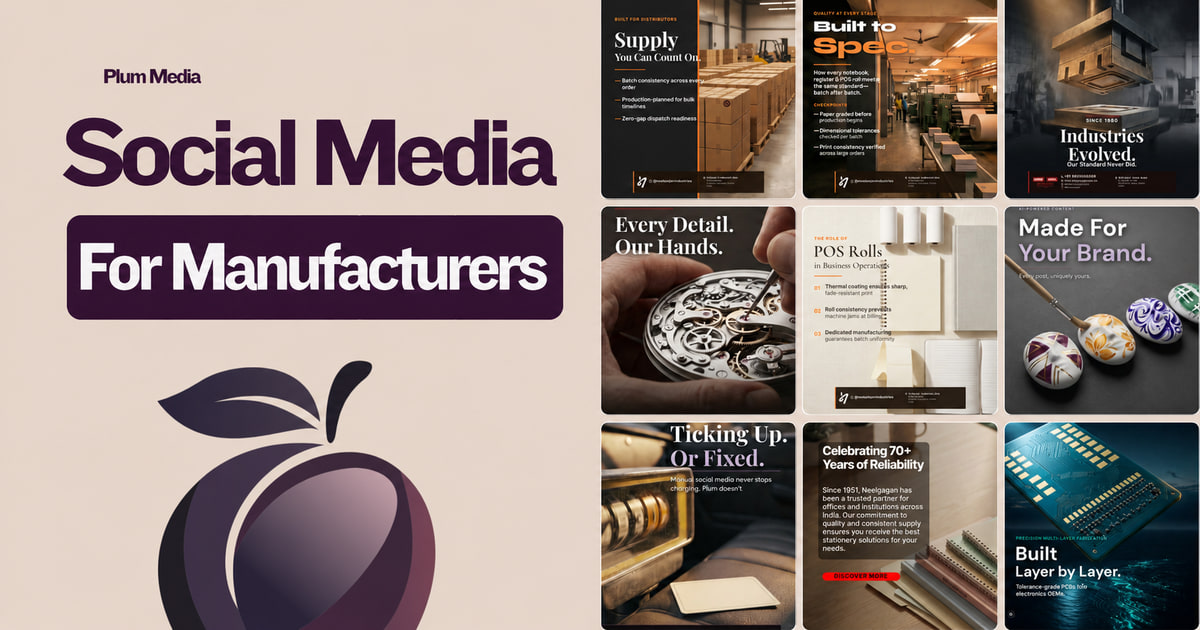
What Is Social Media for Manufacturing?
Social media for manufacturing means consistently publishing content that helps customers understand what a business makes, how it works, and why it can be trusted. Instead of relying only on product promotion, manufacturing businesses usually benefit more from combining expertise, process visibility, educational content, team stories, and proof of work. A practical starting point is publishing 3–4 times per week using a mix of educational, trust-building, and behind-the-scenes content (more on this later).
Why Manufacturing Companies Invest in Social Media?
Many manufacturing businesses grow through referrals, repeat customers, relationships, and years of good work. But when someone hears about the company today, one of the first things they usually do is search online. If they cannot understand what the business does, see recent activity, or build confidence quickly, attention moves elsewhere. Social media helps close that gap. It turns existing expertise into visible expertise…
Build trust before the first conversation
Many buyers evaluate suppliers before reaching out. A visible online presence creates familiarity and reduces uncertainty.
Stay visible between customer cycles
Manufacturing purchases are not always immediate. Regular content helps businesses remain remembered when demand appears later.
Make complex work easier to understand
Processes, materials, quality controls, and outcomes become easier to explain through visuals and short content.
Show proof instead of claims
Production processes, team stories, quality practices, projects, and educational content demonstrate capability more effectively than promotional messages.
Differentiate in industries where everyone looks similar
Many manufacturing businesses present themselves in almost identical ways. Consistent content creates recognition and positioning over time.
Strengthen hiring and partnerships
A visible business attracts not only customers but also potential employees, partners, distributors, and collaborators.
Create compounding visibility
Unlike one-time campaigns, content builds over time. Every post becomes another opportunity to be discovered, remembered, and trusted.
Social media does not replace relationships in manufacturing. It makes those relationships easier to start.
Common Social Media Mistakes in Manufacturing
- Mistake
- Only posting finished products
- Consequence
- Customers rarely understand process or differentiation
- Fix
- Show process and expertise
- Mistake
- Posting only festival greetings
- Consequence
- Creates activity but not meaningful visibility
- Fix
- Create useful and relevant content
- Mistake
- Long periods of inactivity
- Consequence
- Makes business appear inactive
- Fix
- Publish consistently
- Mistake
- Too much technical language
- Consequence
- Hard for buyers to understand
- Fix
- Explain simply
- Mistake
- Only talking about company
- Consequence
- Little audience value
- Fix
- Teach and educate
- Mistake
- Trying to sell in every post
- Consequence
- Lower engagement
- Fix
- Build trust before promotion
A Content Framework for Manufacturing Social Media
Show evidence that helps people believe the business is reliable and capable.
- Quality standards — Explain quality checks, certifications, testing processes, or how consistency is maintained.
- Customer success stories — Share outcomes, problems solved, project highlights, or business impact.
- Process consistency — Show how work stays repeatable across batches, timelines, and operations.
- Company values — Show decisions, practices, and principles that guide how the business operates.
Turn industry knowledge into content that helps customers understand the space better.
- How products are made — Break production into simple steps and explain what happens.
- Industry insights — Share trends, changes, observations, or practical knowledge.
- Material explainers — Explain materials, components, differences, and selection factors.
- Manufacturing myths — Clarify common misunderstandings customers usually have.
Show the people, systems, and work that customers normally never see.
- Factory moments — Share real production snapshots and day-to-day activity.
- Production process — Show stages from raw input to finished output.
- Team highlights — Introduce people and explain their role in making things happen.
- Daily operations — Show routines, systems, preparation, and execution.
Help customers understand what the business offers and where it creates value.
- Applications — Show where and how products are used in real situations.
- Features — Explain what makes the offering useful or different.
- Use cases — Show examples of customer problems and outcomes.
- Comparisons — Explain differences between options, specifications, or approaches.
Show that the business is active, growing, and made up of real people.
- Events — Share exhibitions, visits, launches, or participation moments.
- Company culture — Show how teams work and interact.
- Milestones — Share progress, achievements, and business moments.
- Celebrations — Share festivals, anniversaries, and team occasions with context.
5 Social Media Post Examples for Manufacturing
Real post examples to be added later.
Common Questions
Not every manufacturing company needs to be active on every platform, but most benefit from having a visible online presence. Customers often validate businesses online before contacting them, and consistent content helps create trust before conversations begin.
A balanced mix works best: educational content, production processes, product applications, team stories, quality practices, and customer outcomes. The goal is to show expertise, not just finished products.
A practical starting point is 3–4 posts per week. Consistency matters more than posting every day. Regular publishing creates visibility without becoming difficult to maintain.
The right platform depends on audience and goals. Professional audiences often respond well to educational and expertise-driven content, while visual content can help explain products and processes.
Content should be understandable to the intended audience. Keep expertise visible but explain complex topics in simple language whenever possible.
Social media usually supports awareness, trust, and education first. Over time, this can increase inbound conversations and improve conversion from existing traffic.
Content does not need to reveal confidential details. Businesses can share processes, lessons, people, standards, systems, and industry knowledge without exposing sensitive information.
Results vary, but social media generally compounds over time. Consistent publishing helps businesses become easier to discover, remember, and trust.
How Often Should Manufacturing Companies Post?
Most manufacturing businesses do not need daily content. A practical starting point is 3–4 posts per week using a mix of educational, trust-building, and business content. Publishing consistently usually creates stronger long-term visibility than posting heavily for a short period and becoming inactive.
| Day | Category | Content idea |
|---|---|---|
| Mon | Education | How products are made |
| Wed | Behind the Scenes | Production process |
| Fri | Trust | Customer success stories |
| Sat | Community | Milestones / events |
How products are made
Production process
Customer success stories
Milestones / events
Illustrative example week — not a live scheduler.
Frequently Asked Questions
A practical starting point is 3–4 posts per week. Consistency usually matters more than posting every day.
Not necessarily. Choose platforms based on business goals and where customers are most active.
Educational content, production processes, customer outcomes, and expertise-led posts usually perform well.
Parts of planning, creation, and publishing can be streamlined while keeping content consistent.
Yes. Social media helps businesses stay visible and build trust before conversations happen.
No. Educational and trust-building content usually performs better than constant promotion.
Results vary, but consistent publishing generally compounds over time and improves visibility.
Yes, while avoiding confidential information. Showing systems and expertise often builds trust.
Most businesses already have enough material like processes, people, products, and daily operations.
Track visibility, profile visits, inquiries, and business conversations—not only follower count.
Key Takeaways
Manufacturing businesses already have stories worth sharing.
Trust builds before inquiry.
Educational content performs well.
Consistency beats volume.
Visibility compounds over time.
How Plum Approaches Social Media
Plum is an AI tool that automatically creates and publishes social media content for your business across Facebook, Instagram, LinkedIn, and WhatsApp. You tell us about your business once — what you do — and Plum manages the rest. From planning content to creating posts and publishing consistently, everything is handled through a subscription-based model designed to help businesses stay visible online without adding more work to their day. Stay consistent without requiring constant effort.